AI Workflow Automation for Legal Teams: A Practical Guide
Legal teams are under increasing pressure to move faster while maintaining the same level of accuracy and compliance.
Contracts, due diligence files, compliance documentation, regulatory filings, and case materials all require careful review and validation. Traditionally, these workflows rely heavily on manual effort from associates and analysts.
While this approach ensures thorough oversight, it also creates operational inefficiencies. Legal professionals often spend hours reviewing documents, extracting key clauses, and preparing summaries before senior lawyers can evaluate the information.
This is why many organizations are exploring AI workflow automation for legal teams. Modern AI technologies are enabling legal departments to automate repetitive document-heavy tasks while preserving professional oversight and governance.
In this guide, we explore how AI technologies for scaling legal operations can streamline workflows, reduce manual workload, and help legal teams operate more efficiently.
Why Legal Workflows Are Difficult to Scale
Legal work is built around expertise, but much of the workflow surrounding that expertise is repetitive.
Many legal teams struggle with scaling because of several structural challenges.
High Dependence on Manual Review
Large volumes of documents must be reviewed line-by-line to identify clauses, obligations, and risks. This work often consumes significant associate time.
Fragmented Document Processes
Legal teams frequently work across multiple systems and document formats. Contracts, PDFs, scanned files, and compliance reports may all require different handling processes.
Slow Turnaround Times
When document review processes depend entirely on manual analysis, turnaround times increase, especially during due diligence or regulatory reviews.
Difficulty Scaling Expertise
Hiring additional lawyers to handle increased workloads can be expensive and time-consuming. Firms often reach a growth ceiling when senior professionals become overloaded with review tasks.
These challenges highlight the need for automation in legal workflows, particularly for document-heavy processes.
What Is AI Workflow Automation in Legal Operations?
AI workflow automation refers to the use of artificial intelligence to streamline multi-step legal processes that traditionally require manual intervention.
Instead of automating a single task, workflow automation systems connect multiple steps in a structured process.
A typical AI-assisted legal workflow might include:
Document ingestion and upload
OCR processing for scanned files
Clause identification and extraction
Risk detection and anomaly flagging
Structured document summarization
Review and validation by legal professionals
This approach transforms legal workflows from a manual process into a structured system supported by AI analysis.
Key Applications of AI Workflow Automation for Legal Teams
AI-powered workflow automation is most effective in areas where legal teams handle large volumes of documents.
Contract Review and Analysis
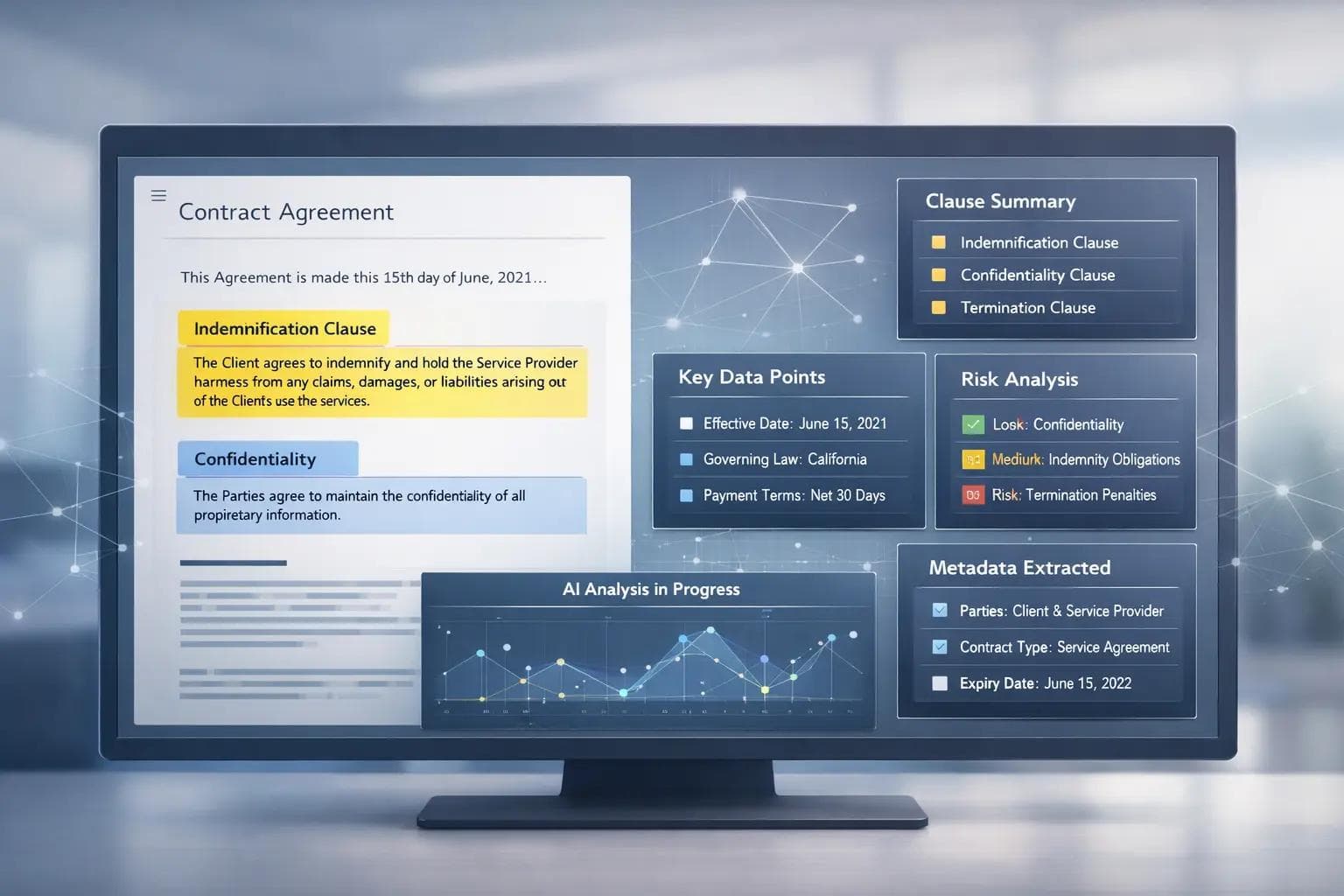
Contracts contain structured legal language that AI systems can identify and analyze quickly. Automated workflows can extract clauses, highlight risks, and organize contract information for lawyer review.
Due Diligence Reviews
During mergers, acquisitions, or investment transactions, legal teams often review hundreds of documents. AI can surface relevant clauses and obligations across multiple files simultaneously.
Compliance Documentation
Regulatory compliance often requires organizations to review extensive documentation. AI automation can help detect inconsistencies or missing information across compliance files.
Litigation Document Preparation
AI systems can organize and summarize case materials, making it easier for legal teams to prepare documentation during litigation.
These applications demonstrate how AI workflow automation for legal teams reduces manual effort while improving efficiency.
How AI Technologies Help Scale Legal Operations
Legal teams are increasingly expected to handle more work without significantly increasing headcount.
This is where AI technologies for scaling legal operations provide significant value.
Faster Document Processing
AI systems can analyze large volumes of text in seconds, dramatically reducing the time required for initial document review.
Improved Consistency
Automated workflows apply the same analysis framework to every document, reducing variability that can occur with manual review.
Structured Information Extraction
AI systems convert unstructured legal text into structured insights, making it easier for lawyers to review key information quickly.
Greater Operational Capacity
By automating repetitive tasks, legal teams can focus on higher-value activities such as negotiation, legal interpretation, and strategic advisory work.
Human Oversight Remains Essential
While automation improves efficiency, AI does not replace legal judgment.
Lawyers remain responsible for interpreting legal implications, advising clients, and making final decisions. AI should be viewed as a tool that assists with document analysis rather than a system that replaces legal expertise.
The most effective implementations follow a human-in-the-loop model, where AI performs structured analysis and legal professionals review outputs before final decisions are made.
From Individual Tools to AI Workflow Systems
Many legal teams initially experiment with individual AI tools that perform isolated tasks such as document summarization or contract comparison.
However, the greatest efficiency gains come from integrated AI workflow systems that automate entire processes rather than individual steps.
These systems combine document processing, analysis, and structured outputs within a single workflow environment.
For example, a document-heavy legal workflow might automatically:
- ingest uploaded files
- convert scanned documents into readable text
- extract key clauses and obligations
- flag potential risks
- generate structured summaries for lawyer review
This type of system-level automation allows legal teams to scale operations without increasing manual workload.
If you're interested in how such systems operate in real-world environments, you can explore how AI systems for legal workflows automate document-heavy legal processes.
The Future of Legal Operations
Legal teams are unlikely to become fully automated. However, AI will increasingly support document-heavy workflows that previously consumed significant manual effort.
Firms that adopt AI-assisted workflows can benefit from:
- faster legal document processing
- improved operational efficiency
- greater scalability
- better consistency in document analysis
As document volumes continue to grow, AI workflow automation will become an important part of modern legal operations.
Frequently Asked Questions
What is AI workflow automation for legal teams?
AI workflow automation uses artificial intelligence to streamline multi-step legal processes such as document review, clause extraction, and compliance analysis.
Can AI automate legal document workflows completely?
No. AI can assist with document analysis and information extraction, but legal professionals must review outputs and make final decisions.
What types of legal tasks benefit most from automation?
Contract review, due diligence, compliance documentation, and litigation document preparation are some of the most suitable workflows for AI automation.