How AI Is Transforming Legal Document Review
Legal teams today are managing more documents than ever before.
Contracts, compliance filings, due diligence reports, litigation documents, regulatory disclosures, and internal legal records all require careful analysis. Traditionally, this work has relied heavily on manual document review performed by associates and legal analysts.
While this approach ensures thorough review, it also creates operational bottlenecks. Reviewing large volumes of documents is time-consuming, costly, and difficult to scale.
This is where AI for legal documents is beginning to reshape how legal teams operate. Advances in machine learning, natural language processing, and document intelligence are enabling law firms to automate portions of the review process while maintaining professional oversight.
In this article, we explore how AI for legal document review is transforming legal workflows and where it delivers the most practical value for modern legal teams.
Why Legal Document Review Has Become a Major Bottleneck
Legal work is inherently document-driven. Whether a firm is conducting due diligence, drafting agreements, or preparing litigation materials, document analysis sits at the center of nearly every legal process.
However, traditional review methods create several operational challenges.
1. High Time Investment
Legal document review often requires associates to manually examine hundreds or thousands of pages of contracts, agreements, or filings. Even straightforward clause identification can take hours across multiple documents.
2. Growing Document Volumes
Digital transformation has significantly increased the number of documents organizations produce. Legal teams must now review larger datasets while maintaining the same standards of accuracy.
3. Inconsistent Review Outcomes
Manual review introduces variability depending on experience level, fatigue, or time pressure. Junior associates may miss inconsistencies or subtle risk indicators.
4. Limited Scalability
Scaling document-heavy workflows typically means hiring more legal professionals. This increases costs and slows firm growth.
These challenges are driving increasing interest in legal contract review AI and document analysis systems.
How AI Works for Legal Document Review
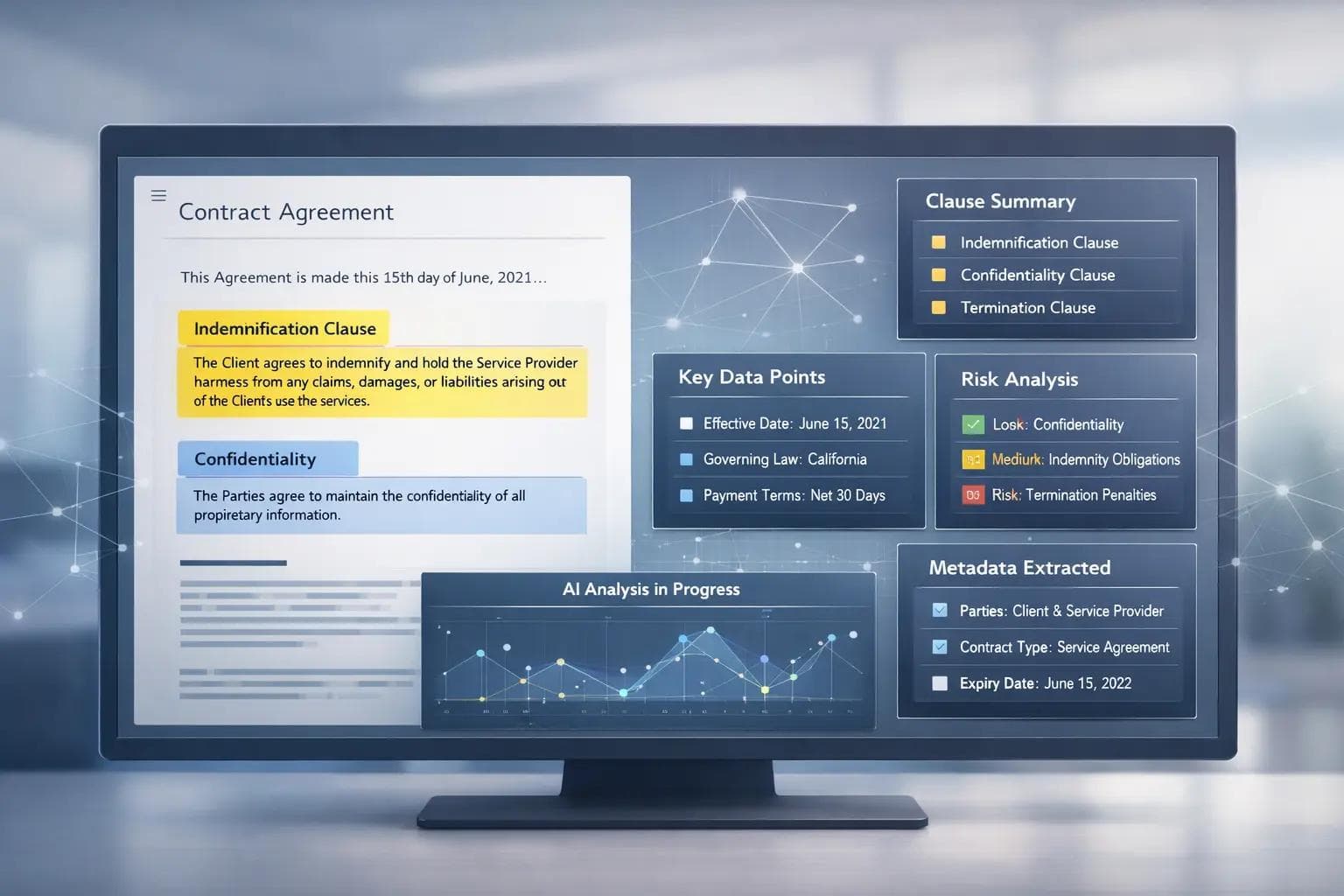
AI-powered legal review systems analyze documents using natural language processing (NLP) and machine learning models trained to recognize legal language patterns.
Instead of reading documents line by line like a human reviewer, AI systems process text at scale and identify patterns, structures, and key clauses within seconds.
Key capabilities include:
Clause Identification
AI systems can detect and categorize clauses such as:
- termination clauses
- confidentiality provisions
- liability limitations
- indemnification terms
- governing law provisions
Risk Flagging
AI tools can highlight unusual language, missing clauses, or deviations from standard contract templates.
Document Summarization
Large documents can be summarized into structured outputs that highlight obligations, timelines, and risk indicators.
Cross-Document Analysis
AI can compare multiple contracts simultaneously to identify inconsistencies or missing information across a document set.
According to research from McKinsey & Company, legal professionals spend a significant portion of their time on tasks that can be partially automated through AI-assisted analysis.
Where AI Delivers the Most Value in Legal Workflows
Not every legal task should be automated. However, certain document-heavy processes benefit significantly from AI-assisted analysis.
Contract Review
AI can accelerate contract review by automatically extracting key clauses and highlighting potential risks. Lawyers can then focus on interpreting implications rather than locating information.
Due Diligence
During mergers, acquisitions, or investment transactions, legal teams must review large volumes of agreements. AI systems can quickly surface relevant clauses across hundreds of documents.
Litigation Preparation
AI tools can organize and summarize case documents, making it easier for legal teams to identify relevant information during litigation.
Regulatory Compliance
AI can analyze compliance documentation and identify inconsistencies that may create regulatory exposure.
These applications demonstrate how AI for legal documents improves efficiency without replacing legal judgment.
What AI Cannot Replace in Legal Work
Despite its capabilities, AI does not replace legal expertise.
Legal reasoning, negotiation strategy, and contextual interpretation remain responsibilities of qualified lawyers. AI should be viewed as an assistive technology that reduces repetitive analysis work.
In practice, the most effective approach is a human-in-the-loop workflow, where AI performs structured analysis and lawyers review outputs before making decisions.
This model ensures both efficiency and professional accountability.
From AI Tools to AI Systems for Legal Workflows
Many early legal AI tools focus on isolated tasks such as document summarization or contract comparison.
However, legal teams increasingly benefit from integrated AI systems that automate entire workflows rather than individual steps.
A modern AI-driven legal workflow might include:
- Document ingestion
- OCR processing for scanned files
- clause extraction
- risk flagging
- structured summary generation
- partner review and validation
These systems transform document analysis from a manual process into a structured workflow supported by intelligent automation.
If you're interested in how such systems work in practice, you can explore how AI systems for legal workflows automate document-heavy legal operations.
The Future of Legal Document Review
The legal profession is not being replaced by AI, but it is being reshaped by it.
As document volumes continue to grow, legal teams will increasingly rely on AI-assisted analysis to maintain efficiency while preserving professional oversight.
Firms that adopt these technologies early can benefit from:
- faster document turnaround
- improved consistency
- reduced operational costs
- greater scalability
AI will not eliminate legal expertise, but it will redefine how legal professionals interact with documents and information.
Frequently Asked Questions
Can AI assist with legal document review?
Yes. AI can analyze contracts, identify clauses, highlight risks, and generate summaries. Lawyers remain responsible for reviewing outputs and making legal decisions.
Is AI reliable for legal document analysis?
AI systems are effective at identifying patterns in legal language and extracting structured information. However, human oversight is essential to validate results and interpret legal implications.
What types of documents can AI analyze?
AI systems can analyze contracts, NDAs, compliance documents, litigation records, regulatory filings, and other legal documents.