How AI Can Automate Property Due Diligence
Property due diligence is one of the most critical steps in any real estate transaction. Before an investment is finalized or a property is transferred, professionals must verify ownership records, validate property documentation, and confirm that all legal and regulatory requirements are satisfied.
Traditionally, this process involves reviewing large volumes of documents and cross-checking information across multiple sources. Legal teams, analysts, and operational staff may spend hours examining property records, tax documents, and compliance forms to ensure the transaction is accurate and legally sound.
As transaction volumes grow and property data becomes more complex, these manual workflows are increasingly difficult to manage.
This is where AI-driven real estate automation is beginning to transform property due diligence.
By using intelligent automation systems, organizations can analyze documents faster, detect inconsistencies earlier, and streamline the verification process across entire property portfolios.
Why Property Due Diligence Is Difficult to Scale
Real estate due diligence requires professionals to validate information across multiple documents and data sources. These tasks are essential for identifying risks before a transaction is completed.
Typical due diligence activities include verifying:
- property ownership records
- land registry documentation
- zoning and regulatory compliance
- property tax records
- mortgage documentation
- legal agreements and disclosures
These documents often originate from different sources and may contain inconsistencies or missing information. Identifying these issues manually requires both time and expertise.
As a result, due diligence teams often face three major challenges.
1. Large Volumes of Documents
Property transactions may involve dozens of documents that must be reviewed and compared. Manual analysis becomes increasingly difficult as document volume increases.
2. Fragmented Data Sources
Property information may be distributed across land registries, municipal databases, legal filings, and financial records. Consolidating this data manually can be time-consuming.
3. High Risk of Human Error
Even experienced professionals can overlook discrepancies when reviewing large sets of documents under time pressure.
These challenges have made property due diligence an ideal candidate for AI-powered automation.
How AI Automates Property Due Diligence
Artificial intelligence systems can automate many aspects of due diligence by analyzing documents, extracting structured data, and comparing information across records.
Instead of manually reviewing every document, professionals can rely on automated systems to identify potential issues and highlight areas requiring further review.
Below are several ways AI real estate automation can streamline the due diligence process.
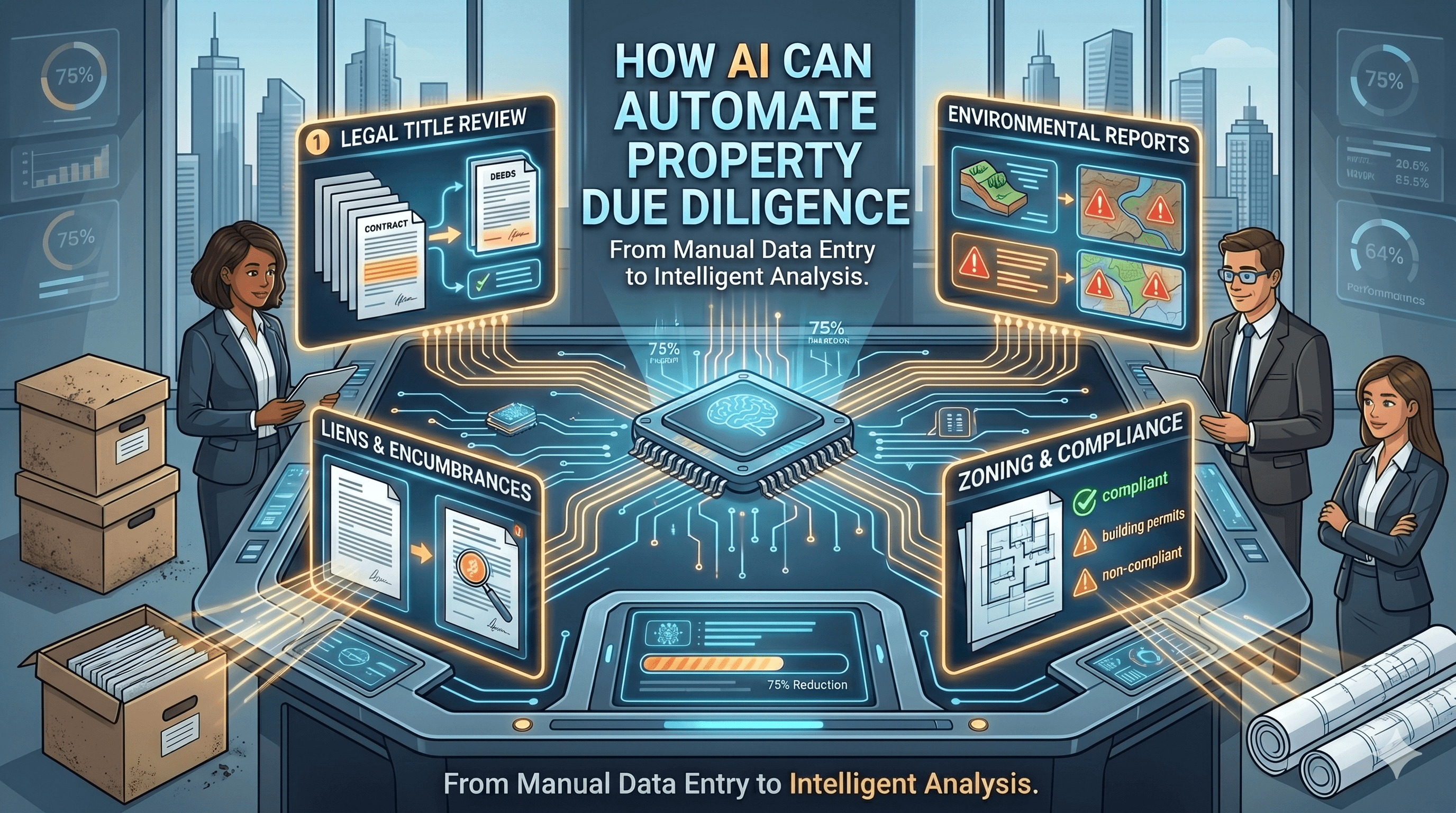
1. Automated Document Ingestion and Analysis
AI systems can process documents in multiple formats, including scanned files, PDFs, and digital records.
Using optical character recognition (OCR) and machine learning models, these systems can:
- extract key information from documents
- identify important fields such as ownership names or parcel numbers
- convert unstructured documents into structured datasets
This allows property records to be analyzed much faster than manual review processes.
2. Cross-Document Data Verification
One of the most valuable capabilities of AI systems is the ability to compare information across multiple documents.
For example, an AI verification system can automatically check whether:
- ownership details match across documents
- parcel numbers correspond with land registry records
- property descriptions remain consistent across filings
If inconsistencies are detected, the system can flag them for human review.
This dramatically reduces the time analysts spend searching for discrepancies.
3. Risk Detection and Anomaly Identification
AI-powered automation systems can also identify unusual patterns or potential risks within property documentation.
Examples include:
- missing or incomplete documents
- conflicting ownership records
- unusual property transfer histories
- incorrect regulatory filings
These alerts help due diligence teams prioritize high-risk cases and investigate them more thoroughly.
4. Automated Due Diligence Reporting
Once documents are analyzed and verified, AI systems can generate structured reports summarizing the results.
These reports may include:
- identified inconsistencies
- missing documentation
- regulatory compliance status
- property verification summaries
Automated reporting helps decision-makers quickly evaluate whether a property transaction can proceed.
Benefits of AI Automation for Real Estate Due Diligence
Organizations adopting AI-powered real estate automation systems can achieve several operational benefits.
Faster Transaction Timelines
Automating document analysis significantly reduces the time required to complete due diligence reviews.
Improved Accuracy
AI systems can process large volumes of data consistently, reducing the likelihood of human error.
Better Risk Visibility
Automated anomaly detection highlights potential risks earlier in the due diligence process.
Operational Scalability
AI automation allows organizations to analyze larger property portfolios without proportionally increasing operational staff.
These improvements can provide a significant advantage for lenders, investment firms, and real estate platforms managing complex transactions.
When Real Estate Firms Should Consider AI Automation
Not every real estate organization requires advanced automation systems. However, firms dealing with large volumes of transactions or complex property records often benefit from AI-powered due diligence tools.
Examples include:
- mortgage lenders reviewing property documentation
- investment firms evaluating multiple acquisitions
- real estate developers managing large property portfolios
- legal teams handling property verification and compliance
For these organizations, AI-driven due diligence automation can significantly improve both efficiency and reliability.
The Future of AI in Property Verification
As AI technologies continue to evolve, real estate due diligence systems will likely become more advanced and integrated into property transaction workflows.
Future systems may provide:
- real-time document verification during transactions
- automated property risk scoring
- predictive analysis of ownership histories
- integration with digital land registries
These developments will help organizations process property transactions faster while maintaining strong verification standards.
Final Thoughts
Property due diligence remains one of the most important safeguards in real estate transactions. However, traditional manual processes are increasingly difficult to manage as property data grows more complex.
AI-powered real estate automation offers a powerful solution by enabling organizations to analyze documents, detect inconsistencies, and generate verification reports more efficiently.
By automating key aspects of the due diligence process, real estate professionals can reduce operational bottlenecks, improve risk detection, and make more informed decisions.
As real estate technology continues to evolve, intelligent automation systems will play an increasingly important role in supporting reliable and scalable property transactions.